Jump Rope Skill 15 min
Three 3-minute rounds of jump rope — basic bounce, alternating-foot, and high-knee — with 1-minute rests. Builds calf elasticity, foot coordination, and Zone 3 cardio in a footprint the size of a bathmat.

Three rounds of 3-minute jump rope — basic bounce, alternating-foot, and high-knee — with 1 minute of rest between rounds, 15 minutes total, builds calf elasticity, foot coordination, and Zone 3 cardiovascular conditioning in a footprint the size of a bathmat.
The session at a glance
- Focus: coordination + cardio
- Intensity: moderate
- Duration: 15 minutes
- Equipment: jump rope (adjust length so handles reach armpits when you stand on the rope)
The protocol
- Warm up — 2 min. Calf raises, ankle circles, and 30 seconds of basic bounce without the rope to set rhythm.
- Round 1 — basic bounce, 3 min. Land on the balls of both feet simultaneously. Keep elbows close to the body; wrists do the rotation, not the arms. Moderate pace, ~100–120 RPM.
- Rest — 60 s.
- Round 2 — alternating foot, 3 min. Shift weight from foot to foot as if jogging in place, one rope pass per step. Pace stays similar; coordination demand increases.
- Rest — 60 s.
- Round 3 — high-knee, 3 min. Drive knees to hip height on each step. Heart rate peaks here. Slow the rope cadence slightly to keep form rather than trip.
- Cool-down — 2 min. Walk it off, then standing calf stretch 30 s per leg.
Why this works
- Calf elasticity and tendon conditioning. Jump rope demands repeated elastic loading of the Achilles tendon and calf — an adaptation that transfers to running economy and ankle stability.
- Coordination under fatigue. The skill demand of keeping rhythm through three progressively harder patterns trains proprioception in a way that steady-state cardio does not.
- Heart-rate elevation. Three-minute rounds at moderate intensity push heart rate into Zone 3 — above easy but below threshold — providing a cardiovascular stimulus distinct from Zone 2 base work.
- Zero footprint. A rope weighs 200 g and fits a bag; the session needs 2 m of ceiling height and 1.5 m of radius.
How to scale it
- If coordination breaks down: reduce each round to 90 seconds and extend rest to 90 seconds while the pattern becomes automatic.
- Progress: add a fourth round, increase pace within rounds, or introduce double-unders in round 3.
- On high-intensity days: combine with sprint intervals (not on the same day) — jump rope fits recovery or low-load days instead.
The rope I travel with weighs nothing in a bag, which is how the fifteen minutes survive a hotel.
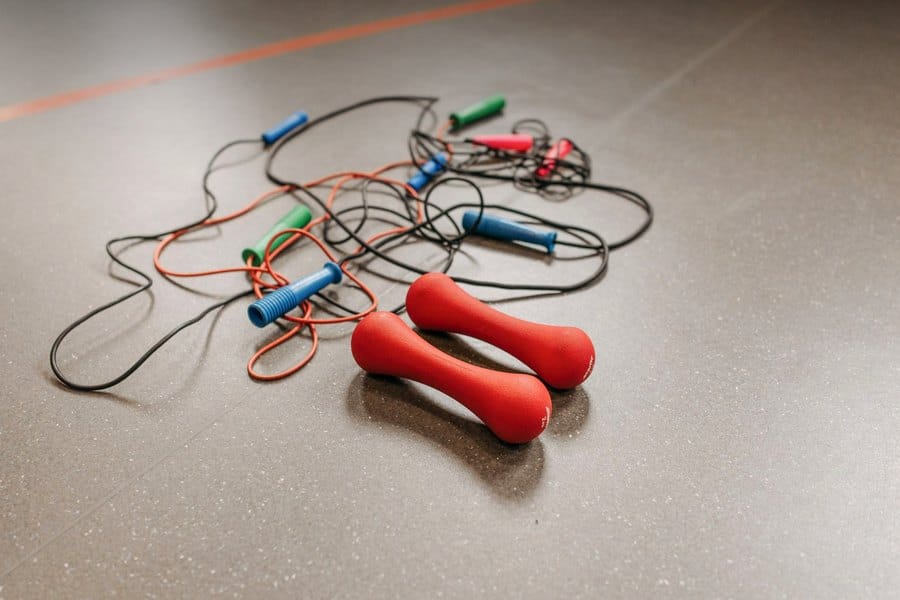
Speed Jump Rope
An adjustable steel-cable rope on ball bearings — the cheapest way to get a real cardio stimulus into fifteen minutes and a square metre of floor.
See it in the shop →Illustrative photo. We may earn a commission — the affiliate link and the full disclosure live on our shop page.
Related protocols
Sources
AgeGen workouts cite authoritative landing pages, not anecdote. If a claim isn't in the linked source, we don't make it.