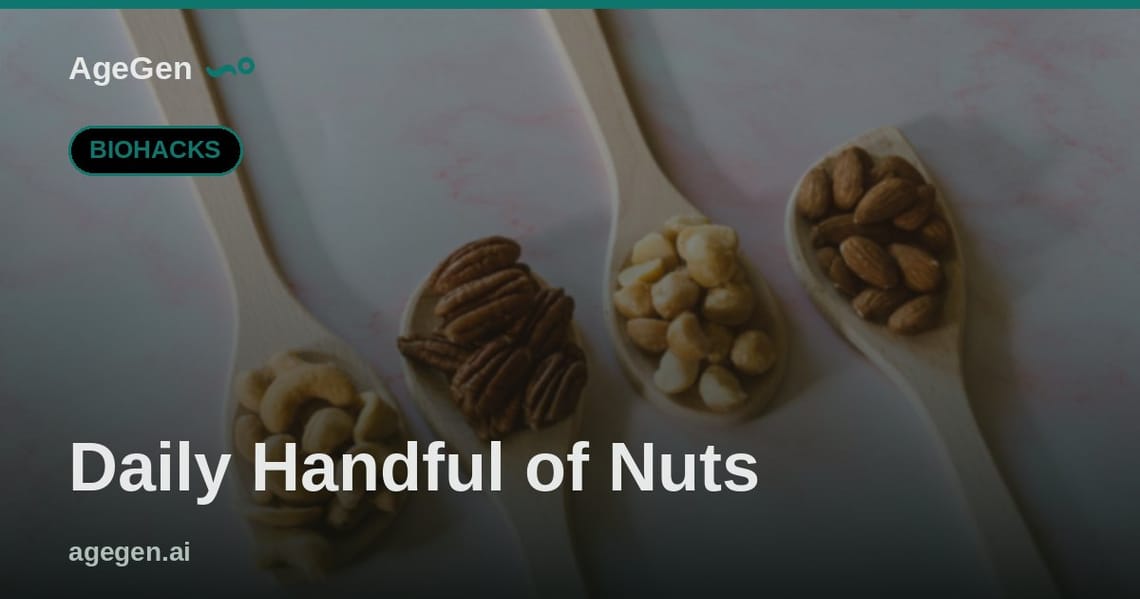
Daily Handful of Nuts
Harvard Health suggests about 30 grams, roughly an ounce, of nuts a day as a habit linked with heart health.
Harvard Health suggests about 30 grams, roughly an ounce, of nuts a day as a habit linked with heart health.
Watch the 25-second version
About thirty grams of nuts a day, roughly one ounce, is a habit linked with heart health.
Transcript & sources → All videosMr. Age is AgeGen's editorial character. Facts come from the protocol above.
The protocol
- Swap: Use nuts in place of another snack, not in addition to it.
- Amount: About 1 ounce (30 g) per day.
- Choose: Plain nuts without added sugar or chocolate.
- Duration: Ongoing.
What you get
- Harvard Health notes that daily nut consumption is linked with heart health, including in the PREDIMED trial of a Mediterranean diet supplemented with nuts.
- Most of the supporting evidence is observational, showing association rather than cause and effect.
Contraindications
- People with a peanut or tree nut allergy should not follow this habit; for them even small amounts can be dangerous, and a provider or allergist decides which nuts, if any, are safe.
- Whole nuts should not be given to children under 5 because they can choke on them.
- People with chronic kidney disease or on dialysis should ask their renal dietitian first, because NIDDK lists nuts among foods that contain phosphorus that kidney patients may need to limit.
- Nuts are calorie-dense, so eat them instead of another snack rather than on top of your usual intake.
Evidence level
Medium. The guidance is consistent across the linked sources but describes patterns, not guaranteed results for any one person. The claims above come from Harvard Health, MedlinePlus, NHS and NIDDK, which publish public-health guidance rather than product claims. Treat this as a habit to try, not a treatment, and weigh it against the contraindications.
Sources
- Harvard Health — Ask the doctor healthy nuts how much should i eat
- MedlinePlus — encyclopedia article 007805
- NHS — Foods to avoid giving babies and young children
- NIDDK — Eating nutrition
AgeGen never invents studies and never recommends prescription drugs by brand. Biohacks are experiments, not prescriptions — honour the contraindications and talk to a clinician if a condition above applies to you.