Balance Drill — Tandem & Single-Leg 5 min
Five minutes of tandem stance, single-leg holds and eyes-closed balance drills — balance is one of the four exercise types the NIA names by name, and the only one that determines whether a fall happens at all.
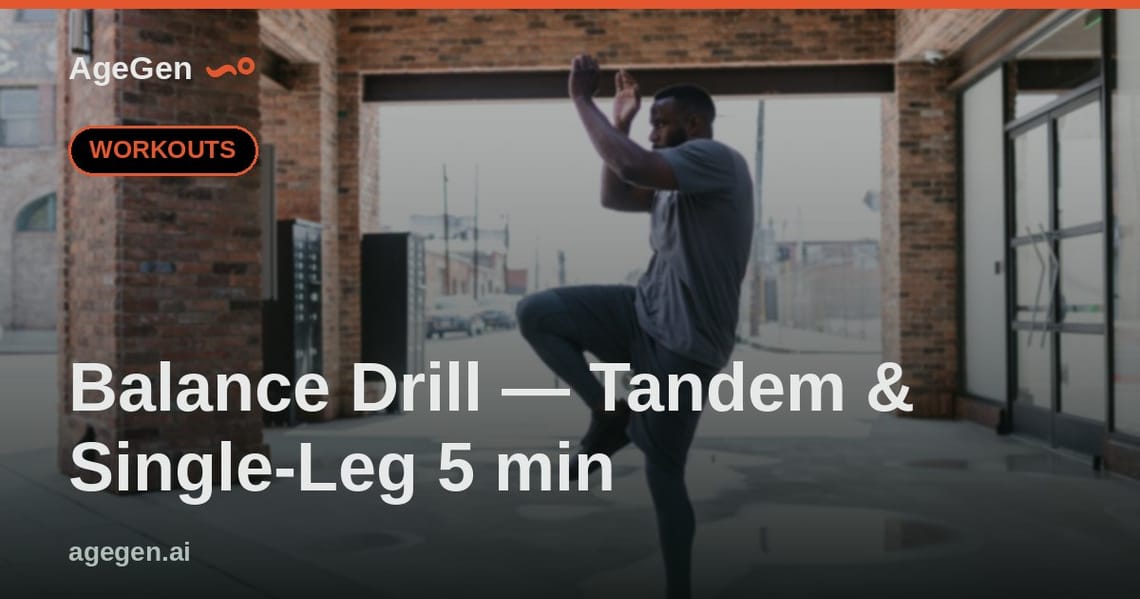
Five minutes of tandem stance, single-leg holds and eyes-closed balance drills — balance is one of the four exercise types the NIA names by name, and the only one that determines whether a fall happens at all.
The session at a glance
- Focus: balance
- Intensity: low
- Duration: 5 minutes
- Equipment: wall or counter
The protocol
- Tandem stance, heel to toe (~60 s): 30 s each foot forward, hand near a wall.
- Single-leg stand (~120 s): 30 s each leg, twice; progress by looking left and right as balance improves.
- Single-leg stand, eyes closed (~60 s): 15 s each leg, twice — only beside a wall or counter.
- Heel-to-toe walk (~60 s): 20 steps, arms out.
Why this works
- Balance is one of the four exercise types the NIA names by name — alongside endurance, strength and flexibility.
- It is the only one that predicts whether a fall happens at all.
- The steps progress from supported (hand near wall, eyes open) to eyes closed — a built-in difficulty ramp that can be applied within a single session as steadiness improves.
How to scale it
- Add challenge in order: progress each stance (tandem, single-leg) by adding the eyes-closed condition before extending the duration — removing vision is a larger difficulty jump than adding seconds.
- The wall proximity is load-bearing: the eyes-closed single-leg stand requires a wall or counter within arm's reach — this is a safety constraint in the protocol, not a beginner accommodation.
- Progress the walk: advance the heel-to-toe walk by slowing the step rate or adding a controlled head turn at each step as balance improves.
Related protocols
- Yoga Sun Salutation — 15-Minute Daily Mobility Flow
- Post-Meal Walk 15 min
- Ankle Mobility — Knee-to-Wall 5 min
Sources
AgeGen workouts cite authoritative landing pages, not anecdote. If a claim isn't in the linked source, we don't make it.