Dance Cardio 30 min
Thirty minutes of moderate-intensity dancing to music you like, at home or in a class. Builds muscle and aerobic capacity and engages the brain's reward circuits.
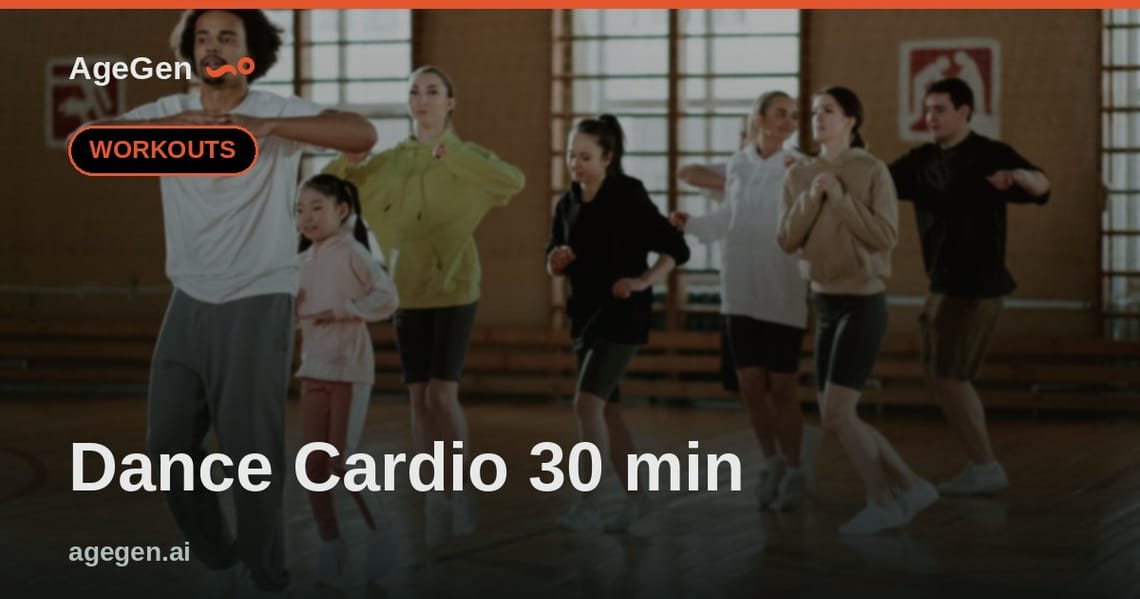
Thirty minutes of moderate-intensity dancing to music you like, at home or in a class — all you need is comfortable clothing, good sneakers and enough space to move freely. Dancing builds muscle and aerobic capacity, and the music itself engages the brain's reward circuits along with its sensory and motor ones.
The session at a glance
- Focus: cardio
- Intensity: moderate
- Duration: 30 minutes
- Equipment: none — comfortable clothing and sneakers
The protocol
- Warm-up — 5 min. March and step-touch to a slow song, bringing the arms in gradually.
- Dance block — 20 min. Continuous dancing at a pace where you can talk but not sing — side steps and grapevines, adding turns only if you can do them with control.
- Cool-down — 5 min. Slow song, easy stepping, then gentle stretches for the calves, thighs and shoulders.
Why this works
- Builds muscle and aerobic capacity. Sustained moderate-intensity movement trains the cardiovascular system the same way any steady-state cardio does.
- Engages the reward system. Because it adds music, dance recruits the brain's reward centres alongside its sensory and motor circuits — part of why it's easier to sustain than a quiet cardio session.
- Scales to any space. No equipment and no gym membership required.
How to scale it
- Drop the turns and keep to simple steps if balance or coordination is a limiting factor.
- Shorten the dance block to 10-15 minutes on lower-energy days and build back up.
- Use the "talk but not sing" pace as the ceiling — if you can't hold a conversation, ease off.
Sources
- Harvard Health — Dance your way to better heart health
- Harvard Health — Let's dance: how rhythmic motion can improve your health
- CDC — Physical Activity Guidelines for Adults
- CDC — Measuring Physical Activity Intensity
AgeGen workouts cite authoritative landing pages, not anecdote. If a claim isn't in the linked source, we don't make it.