Nasal Breathing — Daily Rule
Default to nose-only breathing during all easy activity — walking, low-intensity cardio, desk work, sleep — and switch to mouth breathing only when intensity demands it. Improves CO2 tolerance, sleep quality, and dental health.
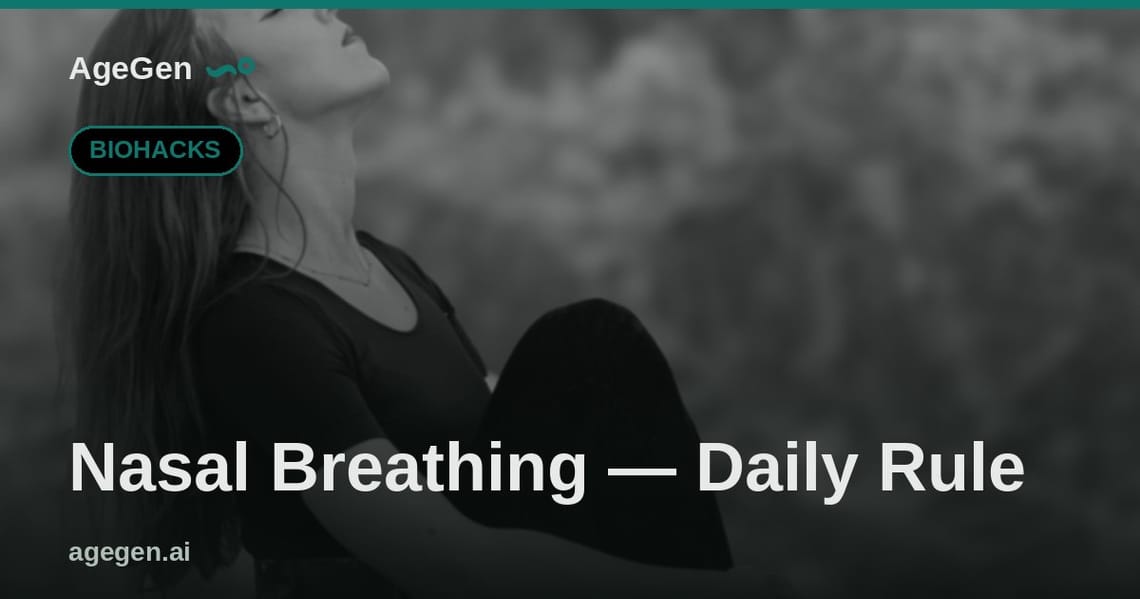
Default to nose-only breathing during all easy activity — walking, low-intensity cardio, desk work, and sleep — and switch to mouth breathing only when the intensity genuinely demands it. Improves CO2 tolerance, sleep quality, and dental health with no equipment and no cost.
Watch the 24-second version
Breathe through your nose by default — walking, low-intensity cardio, desk work, sleep.
Transcript & sources → All videosMr. Age is AgeGen's editorial character. Facts come from the protocol above.
The protocol
- Rule: nose-breathe by default during walking, easy cardio, desk work, and everyday conversation; mouth-breathe only when intensity demands it.
- During exercise: at low and moderate intensities (Zone 1–2), maintain nasal breathing even if it requires slowing the pace initially. Progress comes within 2–4 weeks as CO2 tolerance improves.
- Sleep: if mouth-breathing during sleep is suspected, consider mouth tape — only if cleared by a clinician and after ruling out sleep apnoea.
What you get
- CO2 tolerance. Nasal breathing slows the breathing rate, allowing CO2 to accumulate slightly. This trains the body's tolerance to CO2-driven air hunger — the primary trigger for most people's perceived breathlessness — and can meaningfully raise the pace at which nasal breathing remains comfortable.
- Sleep quality. Nasal passages filter, humidify, and warm incoming air and produce nitric oxide, which supports oxygen uptake and may reduce snoring.
- Dental health. Chronic mouth breathing dries oral mucosa, reduces salivary pH buffering, and is associated in the literature with higher rates of dental caries and gum disease.
Contraindications
- Nasal obstruction from deviated septum or chronic congestion — treat the obstruction before applying this rule.
- Sleep apnoea — consult a clinician before using mouth tape; taping can mask the need for CPAP or create a hazard.
Evidence level
Medium. The physiological case for nasal breathing is well-supported mechanistically — nitric oxide production, air conditioning, CO2 tolerance — and the dental-health link has observational support. Large randomised trials on the behavioural protocol specifically are limited. The intervention is zero-risk for most adults without nasal obstruction and does not require a clinician to trial. Honour the contraindications without exception.
Related protocols
Sources
AgeGen never invents studies and never recommends prescription drugs by brand. Biohacks are experiments, not prescriptions — honour the contraindications and talk to a clinician if a condition above applies to you.