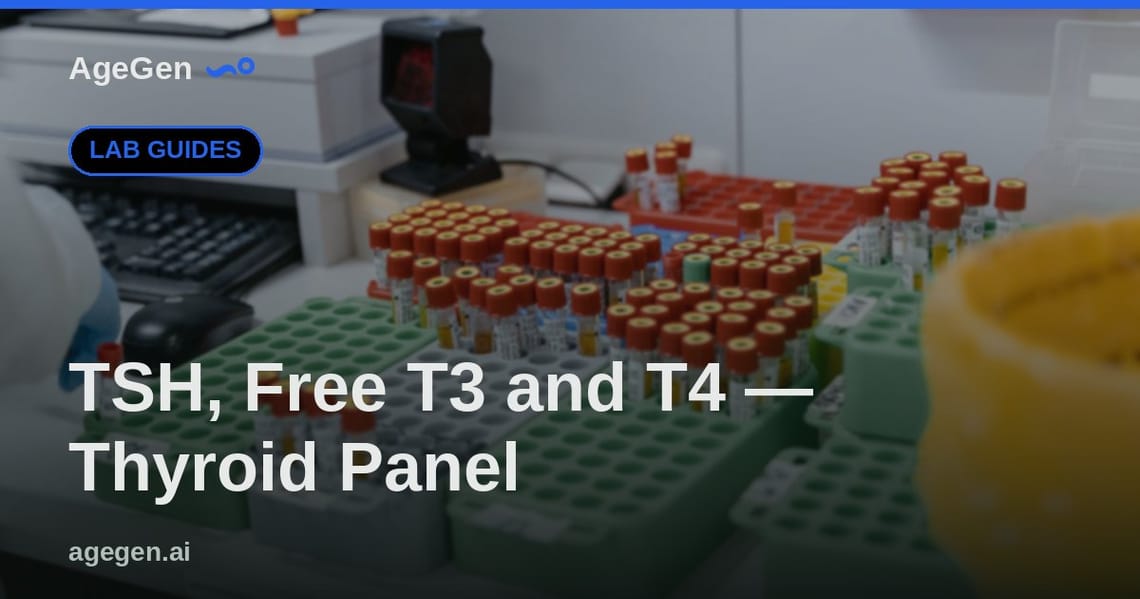
TSH, Free T3 and T4 — Thyroid Panel
TSH measures pituitary signalling; Free T3 and T4 measure the thyroid hormones themselves. The combined panel separates primary thyroid disease from pituitary or conversion issues.
TSH measures pituitary signalling while Free T3 and T4 measure the active and storage thyroid hormones themselves — running the combined panel, not TSH alone, separates a primary thyroid problem from a pituitary or peripheral conversion issue. Most routine panels stop at TSH, which misses anything happening downstream of the pituitary.
Watch the 38-second version
TSH can look normal while the active hormone is not.
Transcript & sources → All videosMr. Age is AgeGen's editorial character. Facts come from the protocol above.
The biomarker
- Name: TSH, Free T3, and Free T4 — Thyroid Panel
- Units: TSH mU/L; T3 and T4 pmol/L
- Standard reference range: TSH 0.4–4.0; FT3 3.1–6.8; FT4 12–22
- Optimal range: TSH 1.0–2.0; FT3 5.0–6.5; FT4 15–22
How to read your result
| Result | Interpretation |
|---|---|
| TSH < 0.4 | Hyperthyroidism — see clinician |
| TSH > 4.0 | Hypothyroidism — see clinician |
| TSH 2.5–4.0 | Subclinical — watch with symptoms |
| FT3 low + TSH normal | Conversion or peripheral issue |
What moves the needle
- Diet. Sufficient iodine, selenium, and zinc — all three are required cofactors for thyroid hormone synthesis and conversion.
- Testing. Add Free T3 and Free T4 if TSH comes back abnormal — TSH alone cannot distinguish a pituitary problem from a peripheral conversion problem.
- Clinician. Endocrinology referral if hypothyroidism or hyperthyroidism is confirmed.
Why this test is worth asking for
- TSH measures the pituitary's signal to the thyroid, not the thyroid's actual hormone output — a normal TSH with abnormal Free T3/T4 still points to a problem.
- The combined panel separates primary thyroid disease (the thyroid itself) from secondary causes (pituitary signalling or peripheral T4→T3 conversion).
- Subclinical patterns (TSH 2.5–4.0 with normal Free T4) are common and easy to miss without watching for symptoms.
Related protocols
- Zinc — Immune + Hormone Cofactor
- Testosterone, Total and Free (Men)
- SHBG — Sex Hormone Binding Globulin
Sources
AgeGen lab guides are educational only. We do not provide medical diagnosis, prescribe brands, or recommend specific doses. Talk to a licensed clinician before changing your supplement or medication routine.