
Mental
Protocols for sleep, stress, focus and mood — wind-down routines, breathing practices, worry windows — each with the mechanism and the research summarised.
Wind-Down Routine — 90 min Pre-Sleep
Dim lights, close work, no screens for the 90 minutes before bed — the transition window is the actual sleep aid. The bedroom is where sleep arrives, not where it is built.

Physiological Sigh — Acute Stress Rescue
Two short nasal inhales and one long mouth exhale, repeated three times — the fastest voluntary way to lower heart rate and offload CO2 in under 60 seconds.
Gratitude Letter — 15 min
A 15-minute weekly practice: write a 300-word letter to someone whose specific action made a difference — one of the most replicated positive-psychology interventions.

Three Wins Journal
A five-minute evening habit: write three specific things that went well today and one reason each happened, building an attentional bias for progress.
Cognitive Defusion — "I notice the thought…"
A two-minute reframe: say "I notice the thought that I am a failure" instead of "I am a failure," using the wrapper to create distance from the thought.
Two-Minute Rule — Task Start
Beat procrastination by committing to a heavy task for just two minutes, since most resistance sits at activation and continuation is usually free once you start.
Single-Tasking Hour
60 minutes on one task — every other tab and app closed, phone face-down on Do Not Disturb — the highest-leverage focus tool when done first each day.
Pomodoro 25/5 Focus Block
A 30-minute focus cycle — 25 minutes on one task with no notifications, then a 5-minute break — that reduces context-switching cost and protects deep work.

Tab Zero — Single Browser Tab
A one-minute focus move: close every browser tab except the one for the task in front of you, because each open tab is an attentional draw that adds up.
Implementation Intention — If/Then
A two-minute planning move: rewrite a goal as "If X happens, then I will do Y" so the trigger is pre-decided and daily willpower is removed.

Dopamine-Fast Morning
The first 60 minutes after waking are phone-free, news-free, social-media-free and caffeine-free — sunlight, water and movement only — to prime natural alertness.
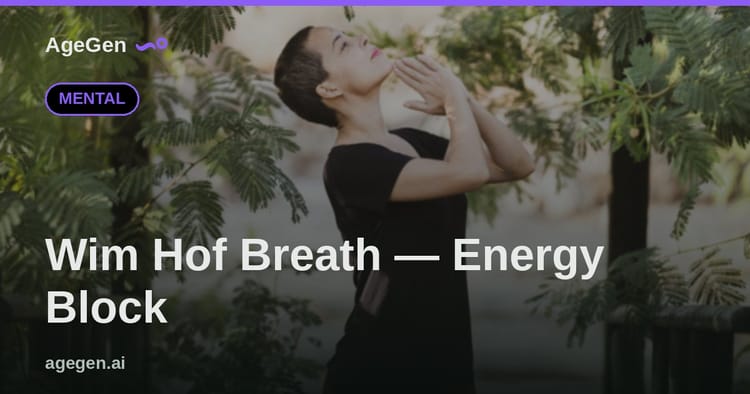
Wim Hof Breath — Energy Block
An 8-minute energy block — three rounds of thirty deep breaths then a comfortable breath-hold — that raises adrenaline and short-term alertness.