Nap Cap — 20 min, Before 3 p.m.
If you nap, keep it to about 20 minutes and take it in the early afternoon — a short nap stays in light sleep and leaves the night alone.
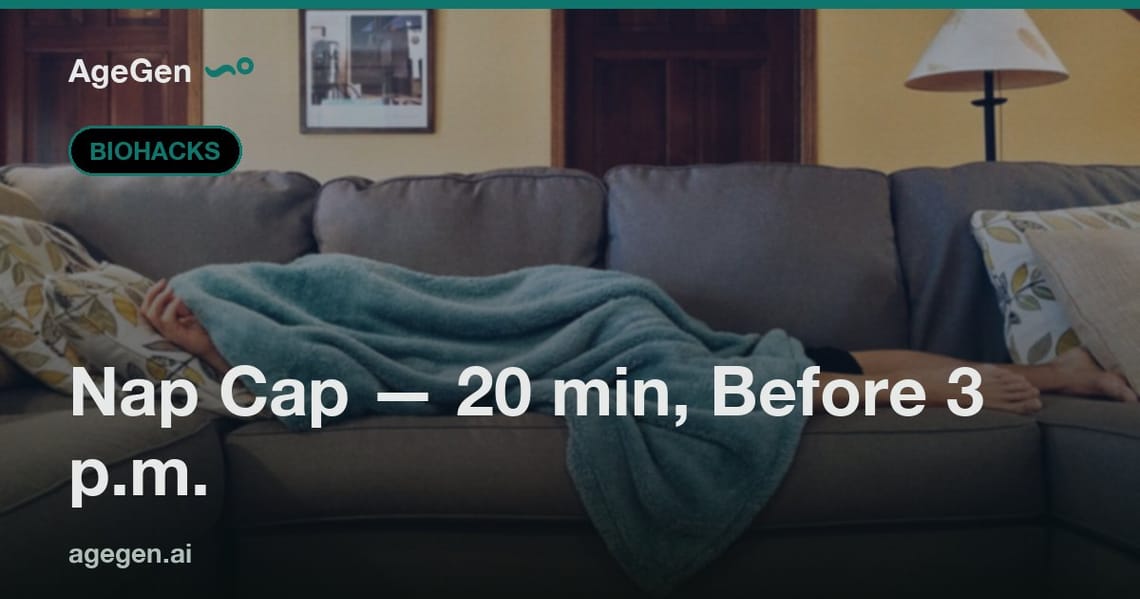
If you nap, keep it to about 20 minutes and take it in the early afternoon — a short nap stays in light sleep, so you wake without deep-sleep grogginess and without eating into the night.
Watch the 22-second version
If you nap, cap it at about twenty minutes and finish before three.
Transcript & sources → All videosMr. Age is AgeGen's editorial character. Facts come from the protocol above.
The protocol
- Length: about 20 minutes, never more than 30 on a regular basis.
- Window: early afternoon, roughly 1–3 p.m.; no naps after 3 p.m.
- Setting: quiet, dark, comfortable temperature, devices out of reach.
- Alarm: set one, and get up when it sounds — stand, stretch or walk for a few minutes.
- After: give yourself a few minutes before anything that needs a quick or sharp response.
- Duration: 2 weeks, then keep it if nights are unaffected.
What you get
- A short nap can restore alertness without deep-sleep grogginess.
- An early-afternoon slot sits in the natural post-lunch dip in alertness.
- A fixed cap keeps the nap from pushing back bedtime.
Contraindications
- If you have trouble falling or staying asleep at night, napping can make it worse — skip naps while that is the problem.
- Needing to nap more than usual, or waking tired in the morning, can point to a medicine, a sleep disorder or another health condition — talk to a clinician rather than napping through it.
Evidence level
Medium. Keeping naps short and early is the standard advice from both sources below, and it rests on how sleep stages work: a nap that ends before deep sleep is easier to wake from. What it does for any one person's nights is the thing to check, which is why the protocol runs for two weeks and stops if nights get worse.
Sources
AgeGen never invents studies and never recommends prescription drugs by brand. Biohacks are experiments, not prescriptions — honour the contraindications and talk to a clinician if a condition above applies to you.